The 22-Second Marketing Lesson Every Brand Missed
Jun 29, 2026
PR
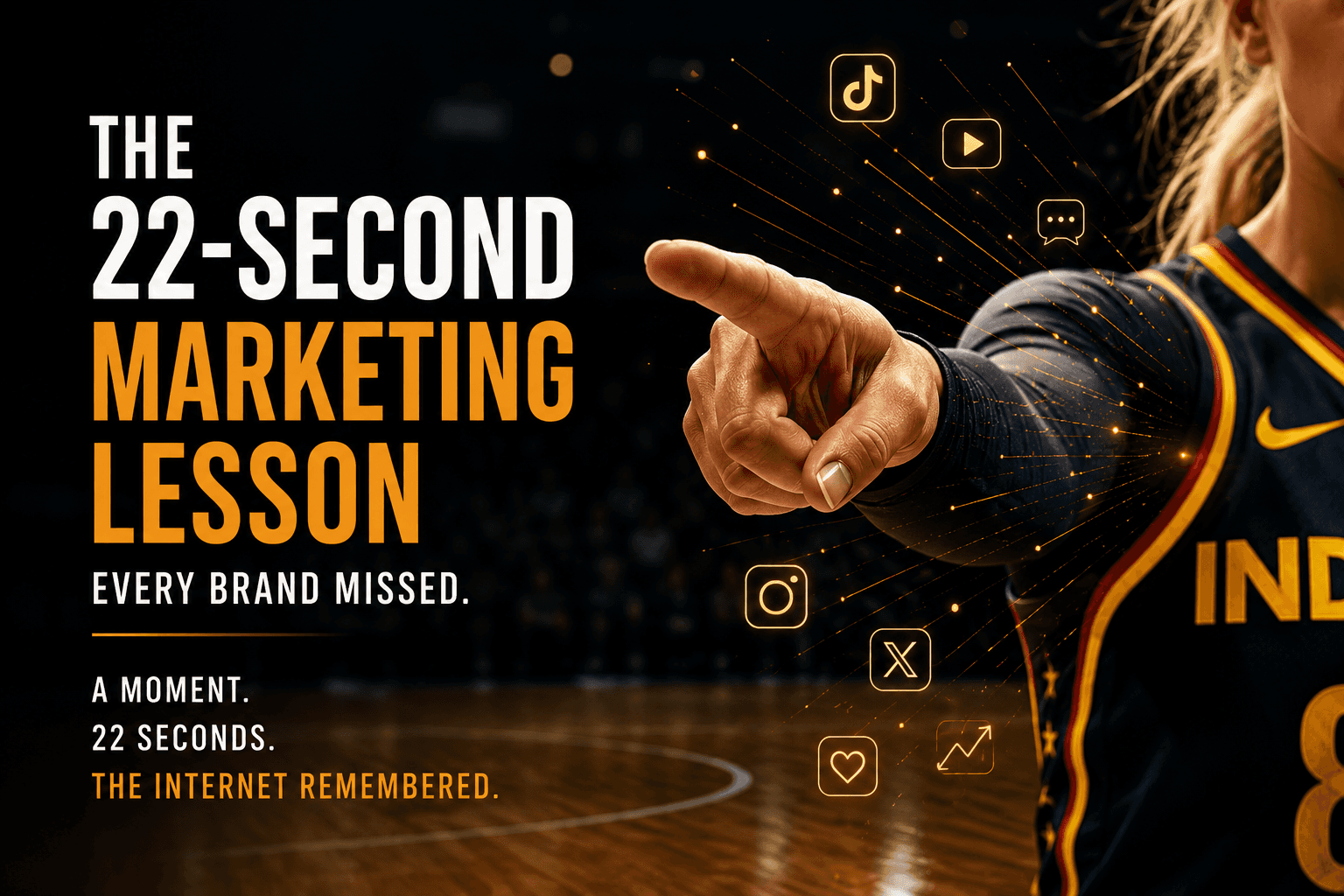
For 22 seconds, Sophie Cunningham didn't say a word.
She didn't celebrate.
She didn't argue.
She didn't give an interview.
She simply pointed.
Within hours, that gesture escaped basketball.
It escaped the sports media.
It escaped ESPN.
It became internet culture.
People who couldn't name a single WNBA player suddenly knew exactly which clip everyone was talking about.
And that's when it became clear.
This wasn't really a basketball story.
It was a communications story.
Attention Doesn't Reward Information. It Rewards Behavior.
Nobody remembers the final score.
Nobody remembers the shooting percentage.
Nobody remembers the rebounding totals.
Most people couldn't tell you what quarter it happened.
But they remember the point.
Why?
Because 99% of people weren't watching the game in the first place. (This whole article is about how these 22-second points brought TONS AND TONS of attention to the sport.)
And for the 1% of people who were…
…Because human beings don't naturally remember information.
We remember behavior.
Our brains are wired to notice emotion, surprise, conflict, symbolism, and recognizable actions. It's how stories have survived for thousands of years.
Facts inform us.
Behavior stays with us.
Marketing often assumes people remember what we tell them.
Reality says they remember what they feel.
The point wasn't important because it contained information.
It became important because it contained meaning.
The WNBA Couldn't Have Bought This
I am sure we would all struggle to think of a marketing campaign led by the WNBA, one of its teams, a player’s personal project, or one of the WNBA sponsors that generated more organic conversation about a role player than these 22 seconds did.
Think about what organizations spend every year trying to accomplish.
Commercials.
Media buys.
Corporate sponsorships.
Influencer campaigns.
Creative agencies.
Social media teams.
Content calendars.
Then compare that to what happened here.
One spontaneous gesture generated:
YouTube breakdowns
Podcasts
TikTok remixes
Memes
GIFs
National sports coverage
Radio discussions
LinkedIn think pieces
Reddit threads
Instagram reels
Group chats
No marketing department could have purchased this outcome.
Because attention like this isn't bought.
It emerges.
Great Marketing Creates Templates, Not Campaigns
Here's what many marketers missed.
People weren't simply sharing Sophie Cunningham.
They were becoming Sophie Cunningham.
Every office suddenly had someone pointing at a spreadsheet.
Every manager.
Every employee.
Every parent.
Every teacher.
Every sports fan.
Everyone had a caption.
The image became a communication template.
That's how internet culture works.
Participation beats observation.
People don't want to consume culture.
They want to contribute to it.
They want to be a part of it.
That's why memes outperform commercials.
They're unfinished.
The audience completes them.
Attention Economics Isn't About Optimization
Modern marketing dashboards obsess over metrics.
CPM.
CTR.
ROAS.
Engagement rate.
Impressions.
Those numbers matter.
But they measure distribution.
They don't measure attention.
Attention isn't created by optimization.
Attention is created by interruption.
Read it again.
Attention is created by interruption.
It's created by surprise.
By emotion.
By conflict.
By novelty.
By participation.
Algorithms amplify what humans react to.
Humans react to what feels impossible to ignore.
Ms. Cunningham's point was impossible to ignore.
That's the real economy every marketer competes in.
What is impossible to ignore?
Moments Are the Atomic Unit of Market Memory
This is the idea I've been coming back to over and over.
Moments are the atomic unit of Market Memory.
Everything starts with a moment.
Without one, there is nothing to remember.
Nothing to quote.
Nothing to search.
Nothing to recommend.
Nothing to teach AI.
Marketing teams spend enormous energy creating content.
Far fewer spend time creating moments worth remembering.
The companies that win the next decade will understand the difference.
The Reputation Graph
In an earlier article, I introduced the idea of the Reputation Graph.
Here's what it looks like in practice.
One gesture became...
↓
Thousands of conversations.
↓
Thousands of social posts.
↓
Thousands of reactions.
↓
Hundreds of articles.
↓
Videos explaining the moment.
↓
Searches from curious audiences.
↓
Recommendations between friends.
↓
References inside AI systems.
Every reaction becomes another node.
Every article becomes another citation.
Every discussion becomes another signal.
One of the reasons why I am blogging about this right now is this signal.
Reputation isn't built by publishing once.
It's built when other people continue the conversation.
And this blog is continuing the conversation, adding to it (hopefully), and grounding the idea that there is something outside of sports and something off the court that we're all dealing with in our own ways… How do we create or tap into a signal to increase the attention on ourselves and our brands?
The Visibility Flywheel
The same moment also demonstrates what I call the Visibility Flywheel.
Moment
↓
Conversation
↓
Coverage
↓
Algorithms
↓
Search
↓
Recommendations
↓
AI retrieval
↓
More conversation
↓
More memory
↓
More visibility
Most organizations stop after publishing.
The companies building lasting visibility keep the flywheel spinning.
Because every new conversation creates another opportunity for discovery.
Marketing Measures Impressions. Markets Remember Symbols.
Marketing reports count impressions.
Markets remember symbols.
Think about the logos, gestures, and images that have become cultural shorthand.
Apple.
Nike.
One red paperclip (was that a stretch?).
The Distracted Boyfriend meme.
Drake pointing in "Hotline Bling."
Now...
Sophie Cunningham pointing.
Not because someone planned it.
Because people remembered it.
Memory compounds.
Every new share makes the symbol easier to recognize.
Every recognition makes the next conversation easier to start.
That's how brands become part of culture.
AI Changes Everything
Twenty years ago, viral moments eventually disappeared.
(And in December of 2027, even Judson Laipply's Evolution of Dance performance is sunsetting.)
But today, viral moments don't disappear.
They become YouTube explainers.
Podcast discussions.
Newsletter essays.
News articles.
Reddit debates.
TikTok reactions.
Search results.
AI summaries.
Future answers from ChatGPT.
Future responses from Gemini.
Future citations in Claude.
Future recommendations from Perplexity.
The internet no longer forgets.
It teaches.
Every public conversation becomes training material for the next generation of information retrieval.
Attention becomes memory.
Memory becomes citations.
Citations become trust.
Trust becomes discoverability.
That's why communications strategy has fundamentally changed.
You're no longer creating content only for today's audience.
You're creating the future knowledge base that AI systems will retrieve tomorrow.
The Real Marketing Lesson
Most companies ask:
"How do we create more content?"
The better question is:
What could happen that would make other people create content about us?
That's where modern communications begin.
Not with publishing.
With participation.
Not with campaigns.
With moments.
Evidence Marketing creates proof.
The Reputation Graph explains how proof spreads.
The Visibility Flywheel explains how attention compounds.
AI Visibility explains how it gets discovered.
But every one of those systems starts in exactly the same place.
A memorable moment.
Because moments are the atomic unit of Market Memory.
The Last Word
The most valuable marketing asset isn't the content your company publishes.
It's the content other people choose to create because of you.
That's the difference between advertising and attention.
Between campaigns and culture.
Between impressions and memory.
Attention is rented.
Memory is owned.
And in the age of AI, remembered moments don't disappear.
They become articles.
Podcasts.
Videos.
Search results.
AI citations.
Recommendations.
They become part of your Reputation Graph.
They power your Visibility Flywheel.
And over time, they become Market Memory.
That's how modern brands are built.
Not one campaign at a time.
One unforgettable moment at a time.
Watch the Moment That Started the Conversation
If you haven't seen the full incident that inspired this article, watch it here:
FULL INCIDENT: Sophie Cunningham Pointing, Caitlin Clark Altercation, and the Viral 22-Second Moment