Market Memory Is the New SEO
May 9, 2026
PR
Market Memory Is the New SEO
Most marketing teams are still optimizing for attention.
AI search is beginning to reward recognition.
That’s an important distinction.
For years, SEO was largely about rankings, backlinks, keywords, and technical optimization. The goal was to win a search result.
But the rise of AI Overviews, ChatGPT, Perplexity, Gemini, and summarized search behavior is changing how brands become discoverable.
Search is becoming synthesized.
Instead of simply returning links, AI systems increasingly generate answers by pulling patterns, mentions, context, repetition, and authority signals from across the internet.
That changes the game completely.
Because in the AI era, visibility is becoming cumulative.
And the brands that show up consistently across trusted channels are far more likely to become part of the answer.
That’s where market memory comes in.
What Is Market Memory?
Market memory is the accumulated recognition a company builds through repeated visibility across trusted channels over time.
It’s what happens when people in an industry keep seeing your company, your executives, your ideas, your customers, and your content across multiple environments repeatedly.
Not once.
Repeatedly.
Market memory is built through:
podcasts
earned media
conference speaking
LinkedIn content
analyst mentions
customer stories
executive visibility
event activations
video clips
searchable blog content
community conversations
Each individual touchpoint matters less than the pattern they create together.
That pattern becomes familiarity.
And familiarity becomes authority.
Why This Matters in the AI Era
This is the shift most companies still haven’t fully recognized.
AI systems synthesize patterns.
They do not simply rank pages.
That means:
repeated mentions matter
authority consistency matters
contextual association matters
cross-channel visibility matters
If your company appears repeatedly across:
podcasts
articles
LinkedIn discussions
conference agendas
analyst reports
customer conversations
…AI systems begin associating your brand with that category.
That association becomes discoverability.
Not because one page ranked #1.
But because your company became part of the broader industry conversation.
This is why many traditional SEO strategies are starting to feel incomplete.
A technically optimized website with little real-world visibility may rank temporarily.
But a company consistently appearing across trusted ecosystems builds something much harder to replicate:
👉 recognition at scale
Booth Traffic Alone Is Not Enough
This is especially important for B2B companies investing heavily in events.
For years, success at conferences was measured through:
scans
booth traffic
badge counts
lead volume
But most event visibility disappears almost immediately.
A packed booth disappears in 72 hours.
Market memory compounds for years.
The companies creating long-term value from events are the ones extending visibility beyond the trade show floor through:
podcast interviews
speaker clips
customer conversations
LinkedIn content
event recap blogs
photos and videos
earned media
post-event storytelling
The real ROI isn’t always the traffic.
It’s the memory created afterward.
The New PR Stack
This is why modern visibility can no longer live inside isolated channels.
PR is no longer just media relations.
Events are no longer just field marketing.
Podcasts are no longer just brand awareness.
Everything now contributes to discoverability.
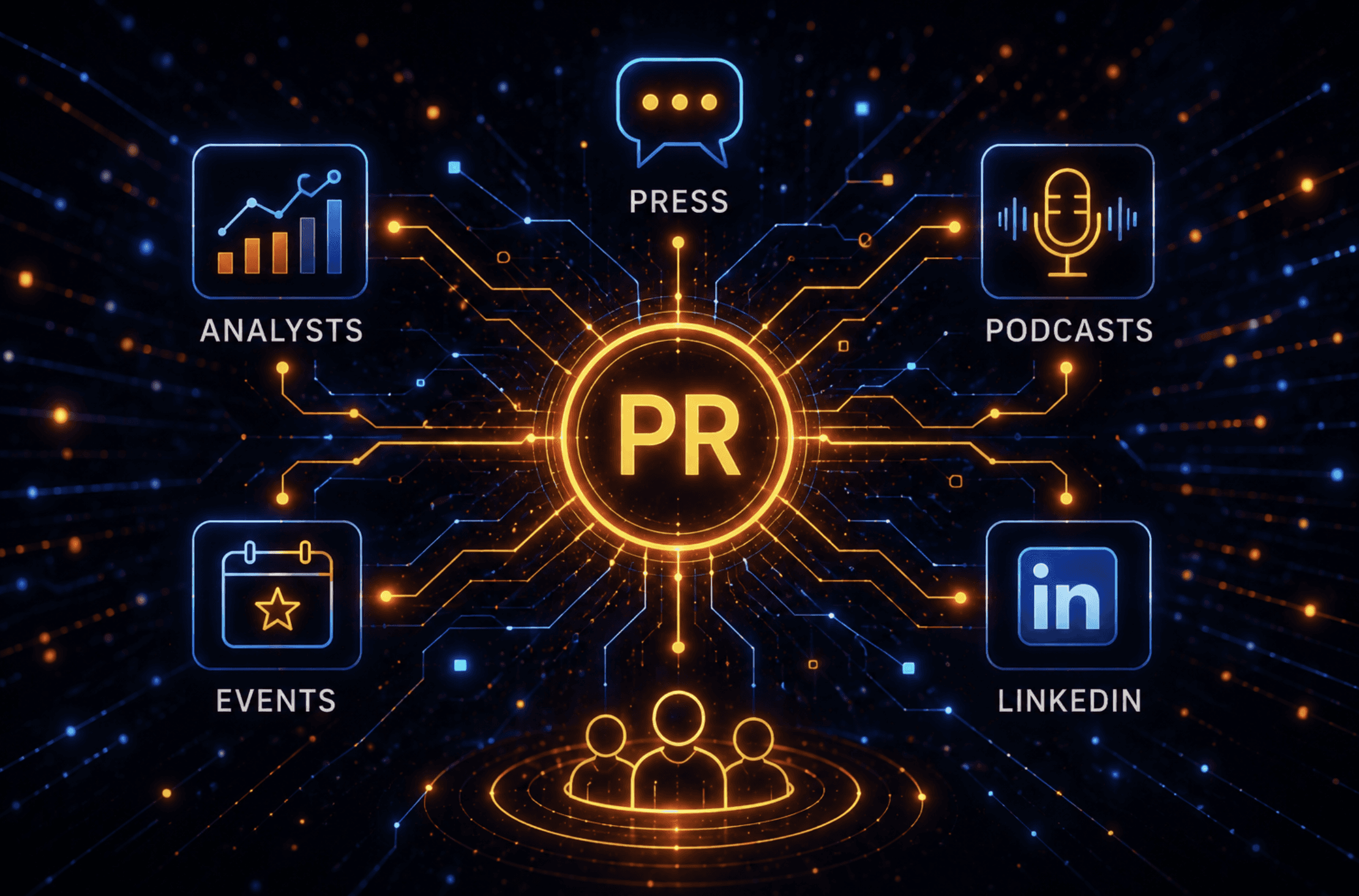
The new PR stack looks more like an ecosystem:
Earned Media
Podcasts
Executive LinkedIn
Conference Speaking
Video Clips
Customer Stories
Analyst Mentions
Searchable Blog Content
Event Activations
AI Discoverability
Individually, each creates visibility.
Together, they create market memory.
And increasingly, market memory influences:
who gets remembered
who gets recommended
who gets summarized
who becomes part of AI-generated answers
The Shift Most Companies Are Missing
Many companies are still optimizing for isolated moments of attention.
A campaign.
A launch.
A press hit.
A trade show.
But AI search is beginning to reward consistency over spikes.
The companies that appear repeatedly over time begin building stronger contextual authority than companies relying on one-off visibility.
That’s why repeated visibility matters more than ever.
Not repetitive messaging.
Repeated presence.
Why This Compounds
One podcast appearance becomes:
a transcript
a clip
a LinkedIn post
a blog mention
a search result
a future citation
One conference speaking session becomes:
photos
clips
conversations
backlinks
customer credibility
future discoverability
One customer story becomes:
social proof
searchable content
category association
AI training data for future summaries
This is how visibility compounds now.
Not linearly.
Systemically.
The Big Idea
The brands that win the next decade won’t simply generate attention.
They’ll build market memory.
Because in the AI era, discoverability is no longer just about ranking.
It’s increasingly about recognition.
And the companies that consistently show up across trusted channels, conversations, and ecosystems won’t just be easier to find.
They’ll be easier to remember.
FAQ
What is market memory?
Market memory is the accumulated recognition a company builds through repeated visibility across trusted channels over time. It’s created through consistent exposure across media, podcasts, events, LinkedIn, analyst mentions, customer stories, and other industry touchpoints.
Why does market memory matter in the AI era?
AI search systems like ChatGPT, Perplexity, Gemini, and Google AI Overviews increasingly synthesize patterns and contextual authority instead of simply ranking individual web pages. Brands that appear consistently across trusted channels are more likely to become part of AI-generated answers.
How is market memory different from SEO?
Traditional SEO focuses heavily on rankings, keywords, backlinks, and technical optimization. Market memory focuses on repeated visibility, recognition, and authority across multiple channels and ecosystems. In the AI era, both matter—but market memory increasingly influences discoverability.
What contributes to market memory?
Market memory is built through repeated visibility across:
earned media
podcasts
executive LinkedIn content
conference speaking
analyst mentions
customer stories
event activations
video clips
searchable blog content
The consistency of visibility matters more than any single placement.
How do events contribute to market memory?
Events create long-term value when visibility extends beyond the conference floor. Podcast interviews, video clips, LinkedIn posts, photos, customer conversations, and earned media all help transform short-term event attention into long-term market recognition.
Why are podcasts important for discoverability?
Podcasts generate searchable and repeatable content through transcripts, clips, social sharing, backlinks, and executive visibility. They help reinforce contextual authority around specific topics and industries over time.
What is the new PR stack?
The new PR stack combines:
earned media
podcasts
executive LinkedIn
events
customer stories
analyst mentions
searchable content
AI discoverability
Instead of operating as isolated channels, these elements work together to build long-term market memory.
How do AI search engines decide what brands to surface?
AI systems increasingly rely on patterns of authority, repeated mentions, contextual relevance, and cross-channel visibility. Brands consistently associated with a category across trusted sources are more likely to appear in AI-generated summaries and recommendations.
Is booth traffic still important at conferences?
Booth traffic still matters, but short-term attention alone rarely creates lasting visibility. Companies that extend event content into podcasts, clips, blog posts, LinkedIn discussions, and customer storytelling create significantly more long-term value.
What’s the difference between attention and recognition?
Attention is temporary. Recognition compounds. A campaign or event may create attention for a few days, while repeated visibility across trusted channels builds long-term familiarity and authority within a market.