Why Press Mentions Are the New Backlinks
DESIGN
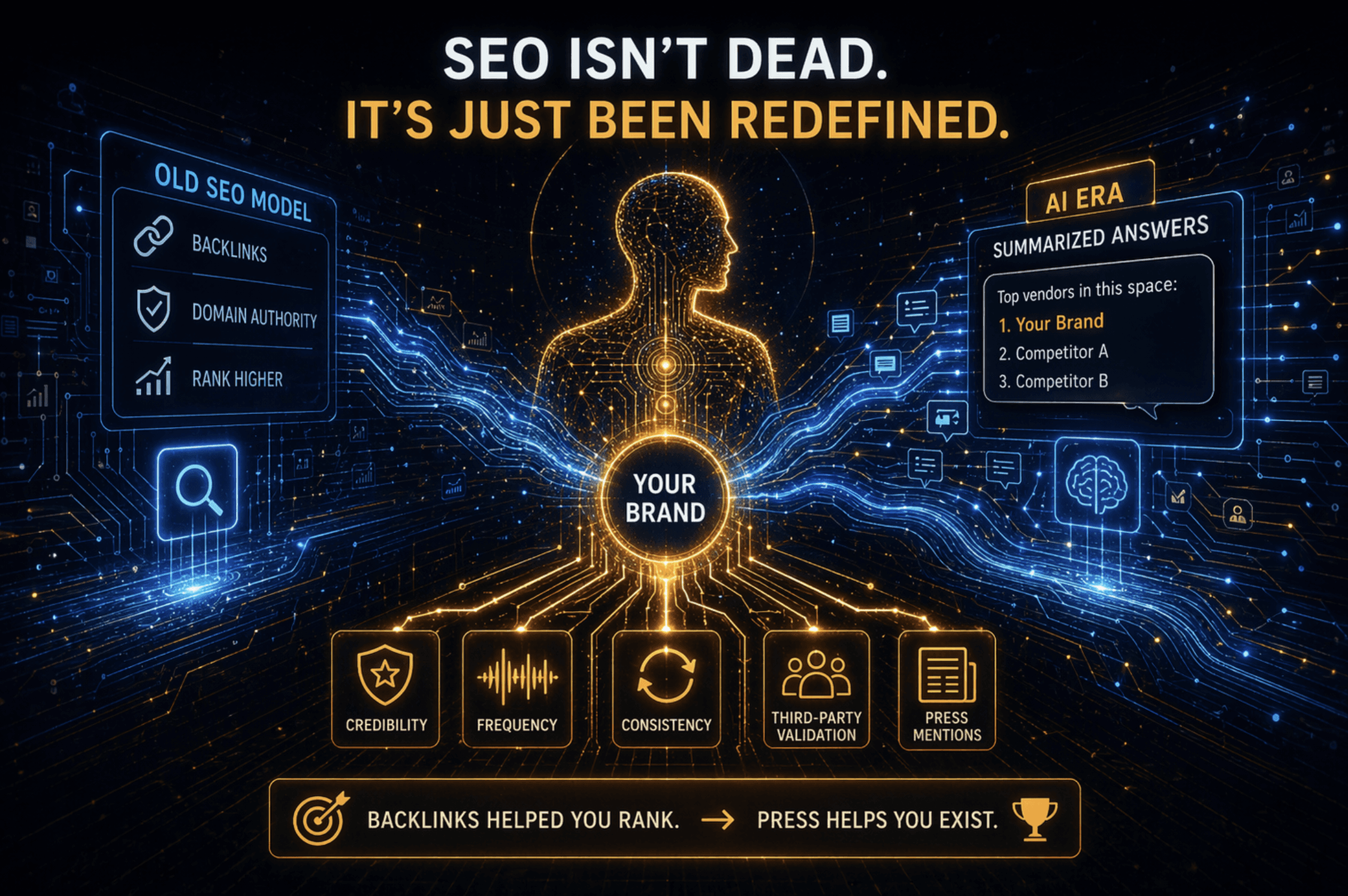
SEO isn’t dead. It’s just been redefined.
For years, the playbook was simple:
get backlinks
improve domain authority
rank higher in search
That was the game.
And it worked.
But that model assumed one thing:
👉 that search engines were the primary gateway to information
They’re not anymore.
The new gatekeepers don’t rank. They summarize.
Today, buyers aren’t just clicking links.
They’re asking:
“Who are the top vendors in this space?”
“What should I use for this problem?”
“What companies are leading here?”
And they’re getting:
👉 summarized answers
No list of 10 blue links.
No deep browsing journey.
Just:
👉 a synthesized view of the market
So what determines who shows up?
Not just backlinks.
Not just SEO.
But signals.
Specifically:
credibility
frequency
consistency
And this is where press comes in.
A press mention is no longer just exposure
It’s a data point.
When your company is mentioned in:
industry publications
news articles
expert roundups
contributed pieces
…it becomes part of the market record
And that record is exactly what AI systems pull from.
Backlinks helped you rank. Press helps you exist.
Backlinks were about:
👉 authority within a search algorithm
Press mentions are about:
👉 presence within a knowledge system
That’s a much bigger surface area.
Because now you’re not just trying to rank a page.
You’re trying to:
be included
be understood
be referenced
be repeated
This is why low-quality SEO tactics are losing power
You can still:
build links
publish content
optimize pages
But if no one else is talking about you…
👉 you’re invisible at the market level
AI doesn’t just trust what you say about yourself.
It looks for:
👉 what others say about you
The compounding effect of press
One mention doesn’t change everything.
But multiple mentions across:
different publications
different contexts
different narratives
…start to build a pattern.
And AI systems love patterns.
This is how brands become “default answers”
When you consistently show up in:
articles
interviews
expert commentary
roundups
You become easier to:
retrieve
summarize
recommend
That’s how you go from:
👉 “a company”
to
👉 “one of the companies”
The shift most founders haven’t made yet
They still think:
👉 “We need more traffic.”
Instead of:
👉 “We need more presence.”
Traffic is downstream.
Presence is upstream.
What this looks like in practice
Modern PR isn’t just about big announcements.
It’s about:
consistent media inclusion
repeatable commentary
thought leadership in the right places
showing up where your category is being discussed
Every mention = another signal.
Every signal = increased visibility.
A simple test
Ask:
👉 “Who are the top companies in [your category]?”
👉 “What tools should I use for [your use case]?”
👉 “What does [your company] do?”
If your brand isn’t showing up…
You don’t have a traffic problem.
You have a signal problem.
The new PR mindset
Stop thinking:
👉 “How do we get coverage?”
Start thinking:
👉 “How do we become part of the dataset?”
Because that’s what AI is reading.
What to do next
1. Increase frequency
One press hit per quarter isn’t enough.
2. Expand surface area
Different publications. Different angles.
3. Stay consistent
Same core positioning everywhere.
4. Prioritize relevance
Industry-specific beats generic reach.
5. Think in signals, not spikes
This is about accumulation, not moments.
The big idea
Backlinks helped you win in search.
Press mentions help you win in AI.
And the companies that understand that shift early…
Are already becoming the answers.
FAQ
Are backlinks still important?
Yes—but they’re no longer sufficient on their own.
What kind of press matters most?
Relevant, credible, and consistent mentions in your category.
How fast does this impact AI visibility?
It compounds over time as signals accumulate across sources.