Field Marketing Is Rising. Events Are Expanding. Here's What Smart PR Leaders Understand
Dec 2, 2025
EVENTS
Field Marketing Representative is one of the fastest-growing roles in the United States, according to LinkedIn’s Jobs on the Rise 2026 report.
At the same time, the 2026 State of Events benchmark report from Bizzabo shows:
40% of organizations plan to host more events this year
Another 40% plan to maintain current event volume
Nearly 80% rank in-person conferences and summits as their most impactful marketing channel
This isn’t a bounce-back moment.
It’s a reallocation of strategic focus.
Companies are reinvesting in presence. In rooms. In conversations. In community.
The question is not whether events work.
The question is whether you’re turning those events into long-term authority and a seven-figure opportunity.
That’s where PR comes in.
The Signal: Companies Are Investing in Relationship Roles
When organizations expand field marketing headcount, they’re signaling something important.
They believe physical presence influences pipeline.
They believe face-to-face engagement accelerates trust.
They believe relationships convert.
Research supports that instinct.
The Edelman Trust Barometer consistently shows that earned credibility and third-party validation outperform paid advertising in trust and influence. Meanwhile, Demand Gen research finds that over 80% of B2B buyers rely on analyst reports, peer recommendations, and independent content before making purchase decisions.
Trust is the currency.
Events are one of the fastest ways to build it.
But trust without narrative leverage fades quickly.
TA Week in San Diego: Designing Relationship Density
At Talent Acquisition Week in San Diego, we helped bring to life what became known as the “Jurassic Hire Party.”
Beach setting.
Tacos.
Campfire.
A 50-foot T-Rex.
No forced intros. No stage ego. No awkward badge scanning.
What made it powerful wasn’t the spectacle.
It was the design.
The relaxed environment allowed real conversations to unfold. Talent leaders, founders, operators, and analysts sat together without pressure. Podcasts were recorded. Social content was captured organically. Brands aligned naturally.
More importantly, something deeper happened:
Relationship density increased.
And in enterprise B2B, relationship density is everything.
Seven-figure deals are rarely closed in booths.
They are cultivated through repeated trust-building interactions across multiple environments over time.
Harvard Business Review research on complex B2B buying cycles confirms that major purchasing decisions involve multiple stakeholders and extended trust development. Events like TA Week accelerate the early layers of that trust curve.
The party wasn’t the strategy.
The relationship architecture was.
Events Without PR Are Expensive Moments
Let’s be clear.
Events are expensive.
Travel. Sponsorships. Production. Time away from teams.
If you host an event and:
Don’t capture story
Don’t extend narrative
Don’t build analyst context
Don’t amplify earned visibility
Don’t connect conversations to broader positioning
Then you’ve hosted a moment — not built momentum.
PR extends the lifespan of every room you enter.
It turns a two-hour conversation into six months of authority.
It connects beach conversations to media mentions.
It connects podcast recordings to analyst briefings.
It connects community gatherings to category leadership.
That is leverage.
Why This Matters for Field Marketing Leaders
Field marketing is rising because companies understand something fundamental:
Revenue is relational.
In-person engagement creates depth that digital alone cannot.
But field marketing alone does not create authority.
PR does.
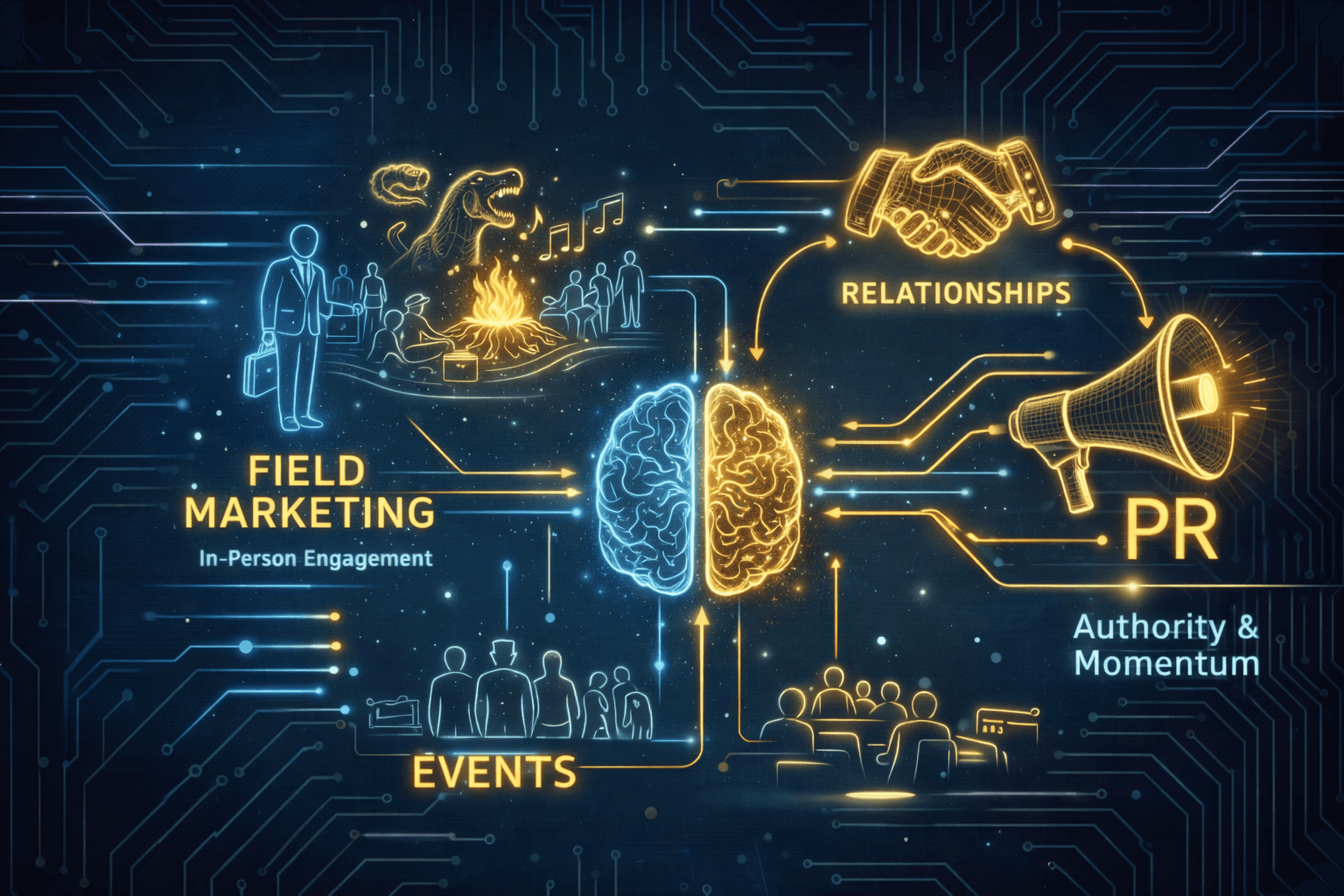
When field activations are aligned with earned media strategy, analyst relations, and narrative consistency, the impact compounds:
Event builds trust
PR builds credibility
Credibility increases influence
Influence drives inbound opportunity
Repeat.
This is how brand gravity is formed.
The Compounding Effect of Earned Media and Relationships
Nielsen research shows earned media is significantly more trusted than paid advertising.
Edelman reinforces that people trust experts and independent voices more than direct brand messaging.
Demand Gen research shows B2B buyers consistently consult third-party sources before purchasing.
That means:
Media builds media.
Relationships build relationships.
Authority compounds over time.
The companies that win long term are not the loudest.
They are the most consistently visible in credible environments.
They show up in rooms.
They show up in research.
They show up in coverage.
They show up in conversations.
And they stay there.
If You’re Increasing Event Investment, Your PR Strategy Should Match
If you're expanding your field marketing team…
If you're increasing event spend…
If you're designing activations, dinners, community gatherings, or industry experiences…
But you’re not aligning those investments with a strategic PR framework…
You’re under-leveraging your opportunity.
Experiences create access.
PR turns access into authority.
And authority is what drives sustained enterprise growth.
If you're planning your 2026 event strategy and want it to generate long-term credibility — not just momentary buzz — let’s talk.
FAQ
Is field marketing growing in 2026?
Yes. LinkedIn’s Jobs on the Rise 2026 report lists Field Marketing Representative among the fastest-growing roles in the U.S., reflecting increased investment in in-person engagement.
Are companies increasing event budgets?
According to the 2026 State of Events benchmark report, 40% of organizations plan to increase event volume and another 40% plan to maintain current levels.
Why does earned media matter in B2B marketing?
Research from Edelman and Nielsen shows that earned media and third-party validation are more trusted than paid advertising, and B2B buyers heavily rely on independent research and analyst perspectives.
Do events influence seven-figure B2B deals?Yes. Enterprise buying cycles are complex and relationship-driven. In-person engagement accelerates trust development across multiple stakeholders, increasing the probability of long-term deal formation.